

The thrilling atmosphere of Crazy Time, a highly engaging live casino game show, often leads players to seek any possible edge in its unpredictable environment. A common practice among enthusiasts is the meticulous tracking and analysis of past results, hoping to uncover patterns or predict future outcomes. The question then arises: does analyzing previous rounds genuinely help your strategy in a game fundamentally built on chance, or is this pursuit of patterns a statistical mirage? This in-depth guide will explore the allure of statistics in this dynamic game, delve into the principles of randomness, and clarify whether such analysis can truly inform your play or merely serves as a fascinating distraction. For more general information about the game, visit crazy-time.network.
The Allure of Statistics: Why Players Track Data
The human mind is naturally inclined to seek patterns, even in chaotic or random sequences. In casino games, this inclination becomes particularly strong, as players hope to find predictability where none truly exists. The availability of historical data, often displayed directly within the game’s interface or via third-party tools, further fuels this desire. Observing a bonus round that hasn’t hit in many spins, or a number that seems “overdue,” can create a compelling (though often misleading) urge to bet on it. This psychological draw is a powerful force, making statistics tracking a popular, albeit often misunderstood, activity among players.
Understanding Randomness: The Core Principle of the Game
At its heart, this game, like most casino offerings, operates on the principle of independent random events. Each spin of the wheel is an isolated incident, completely uninfluenced by previous outcomes. The past results have no bearing on what will happen next, as the wheel has no “memory.” This is a critical concept to grasp, as it forms the bedrock of why conventional pattern tracking does not work for prediction. The outcome of the next spin is determined by a certified Random Number Generator (RNG) for the Top Slot and a physical, unbiased wheel spin for the main segments. Therefore, each spin represents fresh odds.
What Kind of Statistics Can Be Tracked?
For those interested in the numbers, various types of statistics related to this live show can be observed and recorded. While these do not predict future events, they can offer insights into the game’s long-term behavior and confirm its stated probabilities.
Here are common statistics players often track:
- Frequency of Number Hits: How often each number (1, 2, 5, 10) lands over a set number of spins.
- Bonus Round Appearance Rate: How frequently each of the four bonus rounds (Coin Flip, Cash Hunt, Pachinko, Crazy Time) is triggered.
- Top Slot Multiplier Distribution: The range and frequency of multipliers that appear in the Top Slot for different segments.
- Payouts of Bonus Rounds: The actual multipliers achieved within bonus rounds.
- Streaks and Dry Spells: Periods where certain segments hit repeatedly or not at all.
Collecting this data can be a fascinating exercise, allowing players to feel more engaged with the game’s probabilistic nature.
The Gambler’s Fallacy and Its Relevance
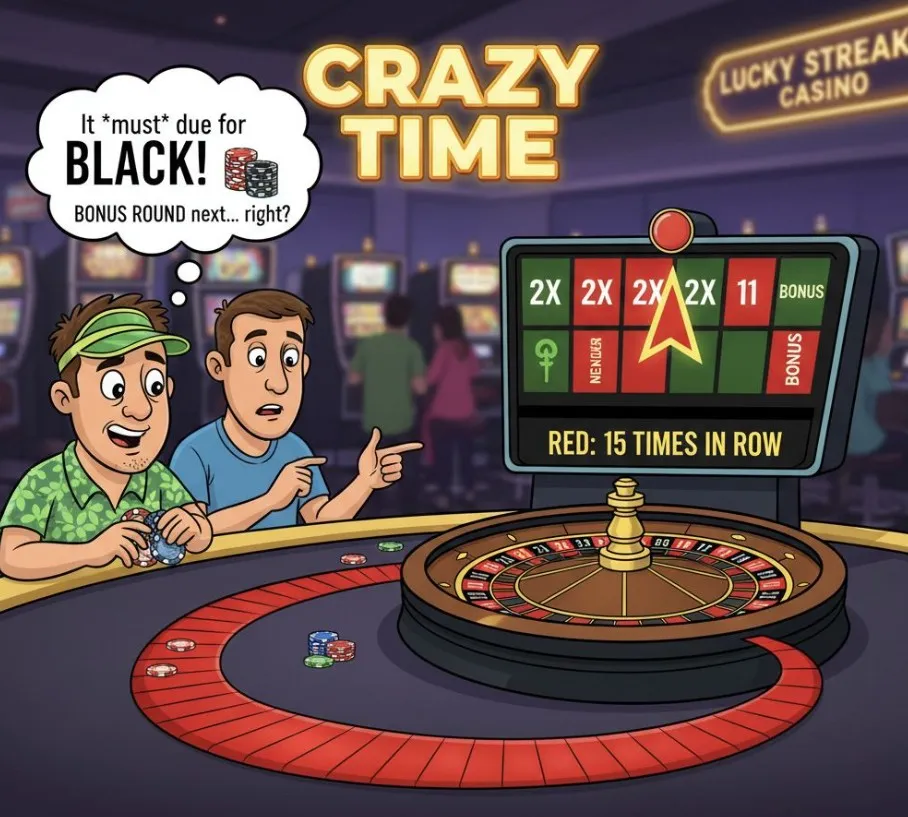
The “Gambler’s Fallacy” is a pervasive cognitive bias that strongly applies to the analysis of past rounds in games of chance. It’s the mistaken belief that if an event occurs more frequently than normal during some period, it is less likely to happen in the future, or that if an event has not occurred for a while, it is “due” to occur. This fallacy is a direct contradiction of the principle of independent random events. For example, if the ‘Crazy Time’ bonus round hasn’t appeared for 50 spins, the probability of it appearing on the 51st spin remains exactly the same as it was for any previous spin, regardless of the prior outcomes. The wheel does not “owe” a bonus round.
How Statistics Can (and Cannot) Inform Your Play
While statistics cannot predict the next spin, they are not entirely without value for the discerning player. Their utility lies in understanding the game’s long-term mathematical framework and confirming its integrity, rather than guiding short-term betting decisions.
This is how statistics can and cannot inform your approach to the game:
How They Can Help:
- Confirm RTP and Volatility: Tracking a large enough sample size can help verify the game’s stated Return to Player (RTP) percentages and its inherent volatility. This provides a realistic long-term expectation.
- Educate on Probabilities: Understanding that ‘Number 1’ appears more often than ‘Number 10’ is a statistical fact that can guide a strategy for bankroll preservation, not prediction.
- Manage Expectations: Awareness of dry spells and streaks from historical data can help players mentally prepare for the game’s natural variance, fostering patience.
How They Cannot Help:
- Predict Future Spins: Past results offer no predictive power for the next outcome due to the game’s inherent randomness.
- Identify “Hot” or “Cold” Segments: The concept of a segment being “hot” (more likely to hit) or “cold” (less likely to hit) is a manifestation of the Gambler’s Fallacy. Each spin resets the probabilities.
- Guarantee Wins: No amount of statistical analysis can provide a winning strategy for a game of pure chance.
Therefore, the value of tracking statistics is more about verifying the game’s design and managing one’s own psychology than about finding a secret formula for success.
Statistical Data vs. Reality in Gameplay
To further illustrate the distinction between observing statistical tendencies and attempting to use them for prediction, consider the following points. While historical data can show patterns, these patterns are descriptive of the past, not prescriptive for the future.
This table highlights common statistical observations versus their actual impact on strategy:
| Statistical Observation | Player Interpretation (often flawed) | Actual Impact on Strategy (correct) |
|---|---|---|
| “Bonus has not hit in 30 rounds” | “Bonus is overdue, I must bet heavily now!” | Probability of bonus remains unchanged for next spin. |
| “Number 1 has hit 5 times in a row” | “Number 1 is hot, I should keep betting on it!” | Probability of Number 1 remains unchanged for next spin. |
| Overall RTP is 96% | “I should win back 96% of my money every session” | RTP is a theoretical average over millions of spins, not a guarantee for a single session. |
This comparison underscores the importance of interpreting statistical data correctly, distinguishing between observation and predictive power.
Conclusion
In conclusion, while the allure of uncovering hidden patterns in Crazy Time through statistics tracking is understandable, it’s vital for players to approach such analysis with a clear understanding of randomness and probability. The game is one of independent events, where past results do not influence future outcomes. Therefore, while observing historical data can be a fascinating exercise that helps confirm the game’s underlying mathematics and allows players to manage their expectations, it cannot provide a predictive edge or guarantee wins. True insight comes not from trying to outsmart the random nature of the wheel, but from understanding its rules, managing your bankroll responsibly, and accepting the unpredictable thrill that makes this live game show so exciting. Embrace the entertainment, play wisely, and enjoy the unpredictable ride!